"NiTARA" is now live on GLOBAL LINKER and Indian BUSINESS PORTAL. Link to ACCESS MARKETPLACE - https://nitaratoys.linker.store/
Why the World is Rediscovering Wooden Toys — And Why India is Uniquely Positioned to Lead
Nikhil Arvind Patel - Founder at Nitara
7/25/20263 min read
Every generation has its defining toy.
For decades, plastic dominated children's playrooms across the world. It was inexpensive, colorful, and easy to manufacture at scale. But today, something interesting is happening.
Parents are asking different questions.
Is this toy safe?
Will it last?
Does it encourage creativity instead of passive entertainment?
Is it sustainable?
What values does it teach my child?
These questions are quietly reshaping the global toy industry.
And in many ways, they are bringing the world back to wood.
More Than a Toy
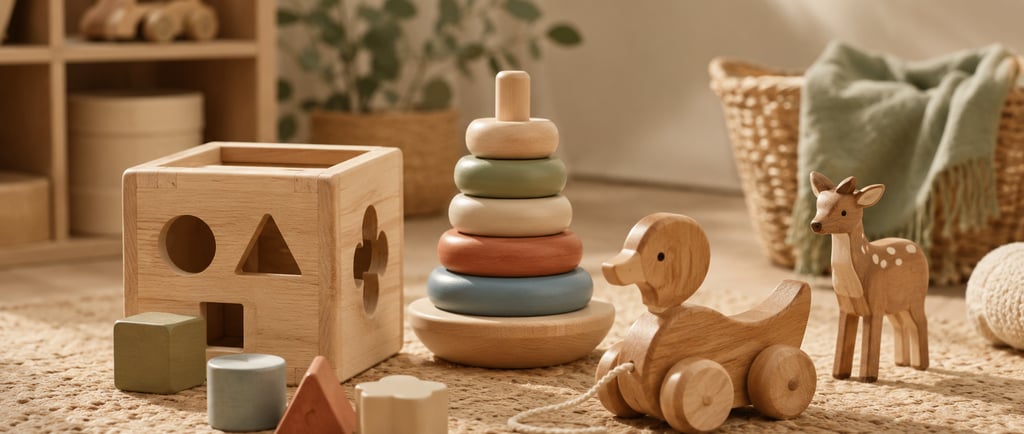
A well-designed wooden toy doesn't flash lights, play music, or need batteries.
Instead, it invites imagination.
A stacker can become a tower, a bridge, or an imaginary city.
A pull toy becomes a child's first companion.
Simple blocks become castles, rockets, forests, or entire worlds.
Open-ended play develops problem-solving, spatial reasoning, fine motor skills, patience, and creativity—skills that remain valuable long after childhood.
Unlike trend-driven plastic toys that often lose their appeal within weeks, wooden toys are timeless. Many become keepsakes, passed from one generation to the next.
That is a different kind of value.
Sustainability Is No Longer Optional
The toy industry is also facing a larger challenge.
Consumers, retailers, and governments are placing greater emphasis on sustainability.
Wood, when responsibly sourced, offers a renewable alternative to petroleum-based plastics.
It requires thoughtful craftsmanship rather than excessive processing.
Its lifecycle is longer.
Its environmental footprint can be significantly lower.
For conscious brands and retailers, sustainability is no longer just a marketing message—it has become an expectation.
Why India?
India's relationship with wooden toys is centuries old.
Long before mass manufacturing existed, Indian artisans were creating educational and handcrafted toys using techniques refined over generations.
Among the finest examples is the GI-tagged craft tradition of Channapatna, often called the "Toy Town of India." These toys are admired worldwide for their craftsmanship, vibrant finishes, and cultural heritage.
But India's strength goes beyond tradition.
Today, the country combines skilled craftsmanship with modern manufacturing capabilities, growing export expertise, and increasing compliance with international quality and safety expectations.
his combination makes India uniquely positioned to serve the next generation of global toy brands.
Not by competing on the lowest price.
But by delivering authenticity, craftsmanship, and value.
The Future Belongs to Thoughtful Design
Modern parents don't simply want toys.
They want products that fit beautifully into their homes.
Products that are safe.
Products that encourage meaningful play.
Products they feel proud to give their children.
That means toy design itself is evolving.
Minimalist aesthetics.
Muted natural colours.
Premium finishes.
Purposeful educational value.
These aren't passing trends—they reflect changing consumer expectations.
The future belongs to products that are designed intentionally, not just manufactured efficiently.
Why We Started Nitara
At Nitara, we didn't start with the goal of selling another toy.
We started with a belief.
That children's products should combine safety, thoughtful design, educational value, and timeless craftsmanship.
As a bootstrapped company, our focus has never been on producing the largest catalogue. Instead, we are building a carefully curated collection of premium wooden toys designed for discerning customers across global markets.
Every product we develop is guided by a few simple principles:
Child-first safety and quality.
Modern designs that parents are proud to display.
Sustainable materials and responsible manufacturing.
Timeless play value rather than short-lived trends.
Respect for India's rich woodworking heritage while embracing contemporary design.
We also believe that India's artisans deserve greater recognition on the global stage—not merely as manufacturers, but as creators of products that combine tradition with innovation.
Looking Ahead
The wooden toy industry is not growing because it is nostalgic.
It is growing because the world is changing.
Parents are choosing quality over quantity.
Retailers are seeking differentiated products.
Brands are investing in sustainability.
Children benefit from toys that encourage imagination instead of passive consumption.
We believe this shift is only beginning.
India has the craftsmanship.
The world has the demand.
Our mission at Nitara is to help connect the two—creating wooden toys that are thoughtfully designed, responsibly made, and built to inspire generations of children around the world.
Sometimes, the future isn't about inventing something entirely new.
Sometimes, it's about rediscovering what always mattered.
Contact
Reach out for B2B export inquiries
Phone
sales@nitaratoys.com
+91 96191 97003 | +91 91525 35216
© 2025. All rights reserved.
The Toy Association of India
Federation Of Indian Export Organisations
GSTIN: 27AAZFN2082Q1Z7
Proud Member of:


GI Tag Products


Certified MSME