"NiTARA" is now live on GLOBAL LINKER and Indian BUSINESS PORTAL. Link to ACCESS MARKETPLACE - https://nitaratoys.linker.store/

What Makes a Toy Truly Great?
Nikhil Arvind Patel - Founder at Nitara
7/25/20263 min read
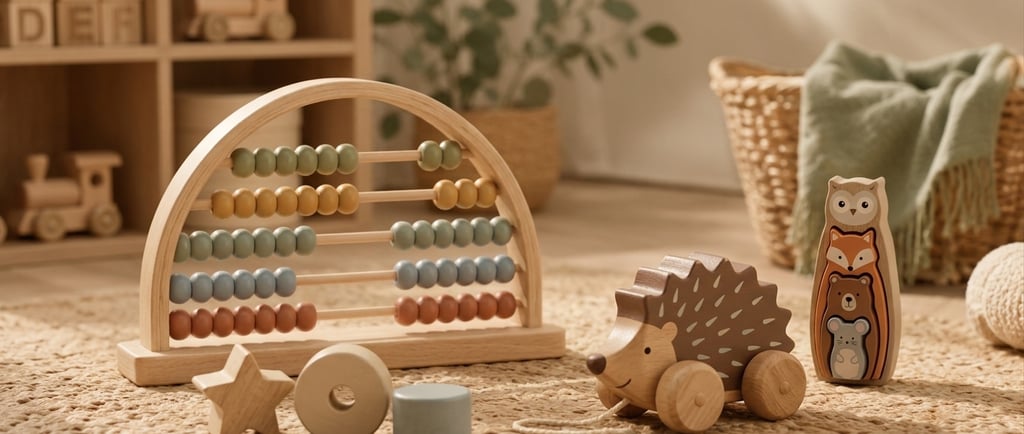
A reflection on play, imagination, and the quiet responsibility of design.
"Every child remembers a favourite toy. Few remember it because of what it could do."
If you ask someone about the toy they loved most as a child, something interesting happens.
They rarely begin by describing the toy itself.
Instead, they tell you a story.
A tiny wooden train that travelled through imaginary countries.
A doll that became a lifelong friend.
A box of blocks that somehow turned into castles, cities and pirate ships.
A faded teddy bear that accompanied every adventure.
The toy is remembered.
But what stays with us is everything that happened because of it.
Perhaps that is the first clue to understanding what makes a toy truly great.
It isn't measured by how impressive the object is.
It is measured by the life it quietly makes possible.
More Than an Object
Adults often evaluate toys the way adults evaluate products.
We compare features, materials, technology, educational claims, safety and sustainability.
These things matter.
They should.
Every child deserves toys that are safe, thoughtfully designed and responsibly made.
But children rarely experience toys the way adults evaluate them.
To a child, a toy is never simply an object.
It is a companion.
A challenge.
A character.
A mystery waiting to be solved.
An invitation to create a world that has never existed before.
That difference is easy to overlook.
Yet it changes everything about how a toy should be designed.
The Space Where Imagination Lives
Watch two children playing with the very same toy.
One builds a city.
The other invents an entire galaxy.
The toy remains exactly the same.
Only the imagination changes.
That observation reveals something remarkably simple.
The true value of a toy has never existed inside the object itself.
It exists in the relationship between the object and the child.
Great toys understand this instinctively.
They leave room.
Room for curiosity.
Room for stories that even the designer could never have imagined.
Perhaps this is why some of the simplest toys remain meaningful across generations.
Not because simplicity is inherently better.
But because possibility never goes out of fashion.
Design Is Also the Art of Restraint
Design is often mistaken for decoration.
In reality, good design is a series of decisions about what not to include.
Architects leave open spaces so buildings can breathe.
Musicians use silence to give meaning to sound.
Toy design is no different.
Every design decision shapes a child's experience.
Some decisions intentionally leave space.
That space is not emptiness.
It is an invitation.
An unfinished story waiting for someone small enough to finish it.
Perhaps the finest toy designers are not those who imagine every possibility.
Perhaps they are the ones wise enough to leave some possibilities undiscovered.
The Measure of a Great Toy
For decades, our industry has celebrated innovation.
As it should.
Innovation has made toys safer, more inclusive and more educational than ever before.
Every generation benefits from that progress.
But innovation is not measured only by complexity.
Sometimes innovation lies in recognising what should remain beautifully simple.
Perhaps the question is not:
"What more can this toy do?"
Perhaps it is:
"What more can this child do because of this toy?"
Those two questions may appear similar.
They lead to entirely different philosophies of design.
One celebrates the product.
The other celebrates the child.
For us, the second question has always been the more interesting one.
Childhood's Invisible Work
To adults, play often looks effortless.
To children, it is serious work.
It is where negotiation begins.
Where confidence quietly develops.
Where problems are solved without anyone calling them lessons.
Where empathy is rehearsed through imaginary conversations.
Where resilience grows because a tower collapses and is built again.
Long before children learn to explain the world, they begin understanding it through play.
That is why great toys rarely compete for attention.
They support something far more important.
The invisible work of becoming.
The Nitara Perspective
At Nitara, we don't begin by asking what a toy should teach.
We begin by asking what it should awaken.
Curiosity before certainty.
Participation before observation.
Imagination before instruction.
A thoughtfully designed toy should never become the hero of play.
The child should.
If, years from now, someone remembers the adventures they created far more vividly than the object itself, we believe the toy has fulfilled its purpose.
Because in the end, the greatest compliment a toy can receive is not that it entertained a child.
It is that it quietly helped a child discover something about themselves.
Reflection
Long after childhood has passed, very few people remember the specifications of their favourite toy.
They remember the worlds they built.
The friendships they imagined.
The stories they invented.
Perhaps that has always been the true purpose of a great toy.
Not to occupy a child's hands.
But to gently expand the boundaries of a child's imagination.
Because every truly great toy leaves behind something far more valuable than memories.
It leaves behind a child who has learned to imagine a world that does not yet exist—and who grows up believing they might one day help create it.
Contact
Reach out for B2B export inquiries
Phone
sales@nitaratoys.com
+91 96191 97003 | +91 91525 35216
© 2025. All rights reserved.
The Toy Association of India
Federation Of Indian Export Organisations
GSTIN: 27AAZFN2082Q1Z7
Proud Member of:


GI Tag Products


Certified MSME